
 Encounters with U.S. Immigration and Customs Enforcement (ICE) can be frightening, confusing, and potentially life-changing. Whether ICE approaches you in public, knocks on your door, or pulls over your vehicle, it is crucial to understand that you have legal rights — and there are steps you can take to protect yourself and your family.
The uncertainty of these situations often causes people to panic or make statements that may later harm their cases. But it is important to remember that everyone—citizens and non-citizens alike—has constitutional rights when dealing with ICE. Knowing what to do in these moments can make an enormous difference in protecting your safety, your family, and your legal future.
Since 1990, Mitchell S. Sexner & Associates LLC has recovered millions of dollars for clients whose rights have been violated by local police departments and federal law enforcement agencies such as ICE. A former criminal prosecutor, attorney Mitchell Sexner leads a legal team that combines nationally recognized representation in civil rights violations alongside award-winning criminal defense services. The office can be reached 24/7 for free information without any obligation at (312) 644-0444.
You Have the Right to Remain Silent
One of the most important rights you have during any ICE encounter is the right to remain silent. You do not have to answer questions about your immigration status, where you were born, how you entered the country, or whether you have family members who are citizens or lawful permanent residents.
If you choose to remain silent, the safest way to assert your rights is by calmly stating:
“I am exercising my right to remain silent.”
You Do Not Have to Show ID or Immigration Documents (in Most Situations)
In a typical street encounter with ICE, you do not have to provide identification, Social Security numbers, or immigration papers unless:
- You are under arrest, or
- You are a non-citizen in possession of immigration documents that you are legally required to carry.
Most people are not required to present documents unless ICE has already placed them under arrest. You may simply repeat:
“I am choosing to remain silent.”
Never present false documents and never lie about your status — untruthful statements can be used against you in future proceedings.
ICE Cannot Enter Your Home Without a Judicial Warrant
ICE frequently attempts to arrest people at home, often early in the morning. But you do not have to open your door unless ICE presents a warrant signed by a judge. Most warrants issued by ICE — Forms I-200 or I-205 — are administrative warrants signed by supervisors, not judges. They do not authorize ICE to enter your home without your permission.
If ICE knocks on your door:
- Do not unlock the door.
- Ask them to show you the warrant through a window or to put the warrant under the door.
- Check whether it is signed by a judge and includes your correct name and address.
If the warrant is not signed by a judge, you may safely say:
“I do not consent to entry.”
If ICE Stops You in Public
ICE also regularly conducts stops at workplaces, bus stops, train stations, and in community areas.
During a public stop:
- You have the right to remain silent.
- You have the right to refuse to answer questions about your status.
- You may ask if you are free to leave.
- If the officer says “yes,” you should walk away calmly and without running.
If an ICE officer tells you that you are not free to leave, you are being detained — but even while detained, you are not required to answer questions.
You may also legally record the encounter with your phone, as long as you do not obstruct or interfere with the officers.
If ICE Stops Your Vehicle
If ICE pulls you over while driving:
- Keep your hands visible.
- Provide your driver’s license, registration, and proof of insurance if requested.
You do not have to answer questions about immigration status, your country of birth, or how you entered the U.S.
ICE often conducts traffic stops alongside local police, a practice that has led to civil-rights lawsuits in many states. Regardless of the officer’s agency, your Fifth Amendment rights apply. You may state:
“I do not wish to answer any questions.”
Do not flee, resist, or physically interfere — remaining calm protects you and strengthens your legal options later.
If ICE Arrests You
If ICE places you under arrest:
- Do not resist.
- Ask for a lawyer immediately.
- Do not sign any documents unless your attorney advises you to. Many forms include waivers that allow ICE to deport you quickly.
- You have the right to call your attorney or family.
- You do not have to answer questions other than your name.
Even undocumented individuals have the right to due process, and many defenses may still be available.
If ICE takes you to a detention center, request an attorney and avoid giving statements about your immigration history, criminal record, or family ties. These details can be used against you later.
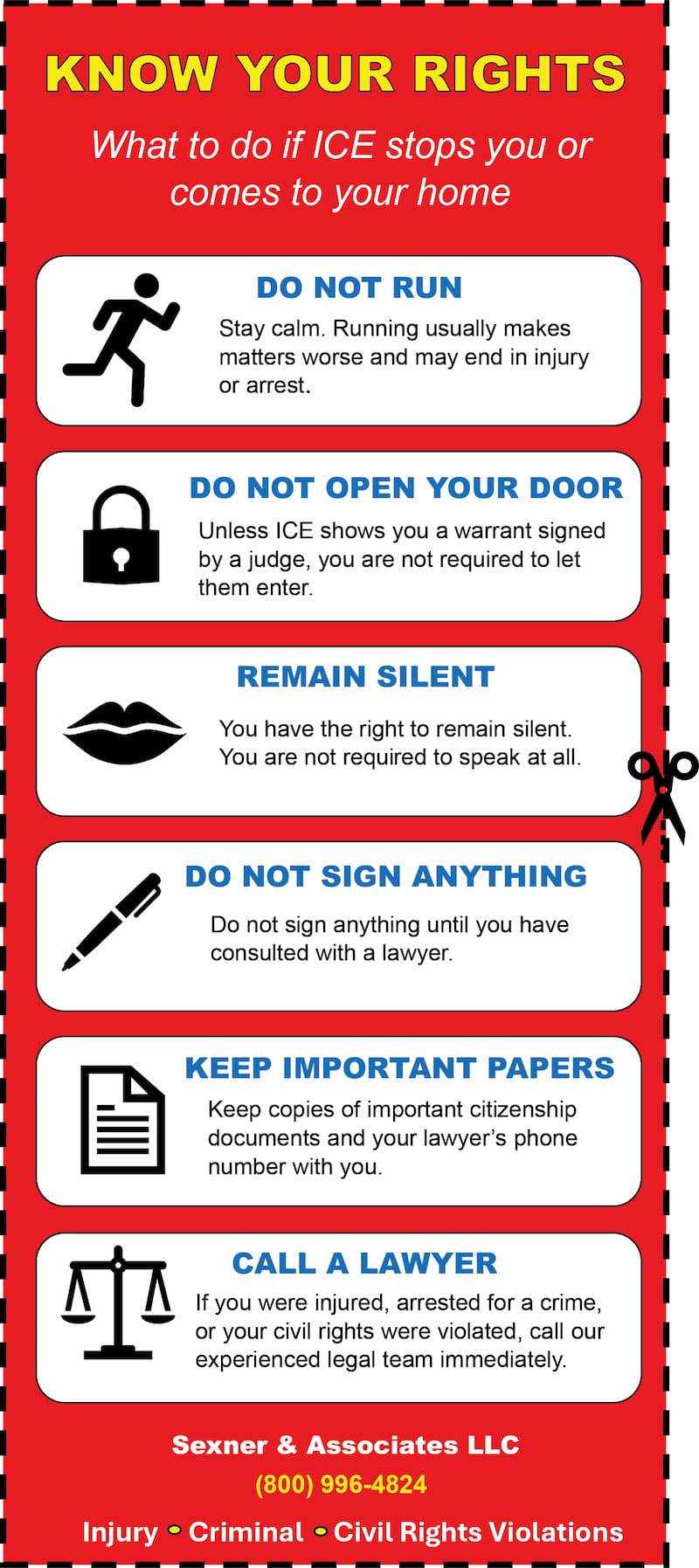
Your Right to Contact an Attorney
It is essential to speak with a lawyer as soon as possible following an ICE arrest, detention or injury. An immigration or criminal-defense attorney can:
- Challenge improper arrests
- Fight removal proceedings
- Seek bond or release
- Argue for suppression of illegally obtained evidence
- File emergency motions, such as stays of removal
At Mitchell S. Sexner & Associates LLC, our attorneys have decades of experience defending the rights of individuals during police encounters. We regularly assist clients who are detained, questioned, or arrested in connection with immigration enforcement actions that result in arrest, injury or violation of civil rights. Our attorneys are not immigration attorneys however, and specific questions regarding immigration should be directed to an attorney that specializes in immigration law.
Real-World Examples That Show Why Knowing Your Rights Matters
Here are some real examples that show how exercising your rights can prevent unnecessary detentions and, in some cases, protect families from being torn apart.
- During coordinated sweeps, ICE officers knocked on doors without judicial warrants, claiming they “just wanted to talk.” Many families unlocked their doors unnecessarily and were immediately detained. Legal-aid organizations documented dozens of cases in which people could have safely declined to unlock the door.
- ICE agents boarded Greyhound buses and demanded identification from passengers. Courts and civil-rights groups later confirmed that passengers were not required to answer questions or show ID. People who remained silent were often left alone.
- Travelers were questioned by agents claiming to conduct routine “status checks.” Several individuals who remained silent or asked if they were free to leave avoided detention because officers lacked probable cause to arrest them.
How Mitchell S. Sexner & Associates LLC Can Help
For more than 35 years, Mitchell S. Sexner & Associates LLC has stood with individuals and families facing aggressive enforcement actions in Illinois. Our attorneys have successfully defended countless clients charged with criminal offenses, unlawful stops, disorderly conduct, resisting arrest, and other allegations that arise from encounters with ICE and law enforcement.
If you or a loved one has been targeted by ICE and as a result has been arrested, injured, unlawfully detained, or have had their civil rights violated, contact us immediately. The earlier our attorneys become involved, the better positioned we are to protect your rights.
Our phone lines are open 24/7 and we offer free consultations. Our legal team has earned numerous distinctions for excellence in criminal defense and civil-rights litigation, recovering millions of dollars for our deserving clients and their families. Whether you were arrested or injured while protesting ICE actions or believe your constitutional rights were violated, our legal team stands ready to protect your freedom, your record, and your future. We can be reached at (312) 644-0444.